
About six months after Seattle Public Utilities started the Roadside Raingarden Pilot Project in Ballard (.pdf map here), many residents who live next to them are upset. Nearly 75 people gathered to voice their anger, concerns and frustrations to members of Seattle Public Utilities at an emotional meeting Wednesday night.
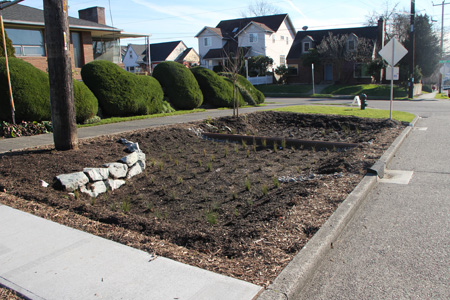
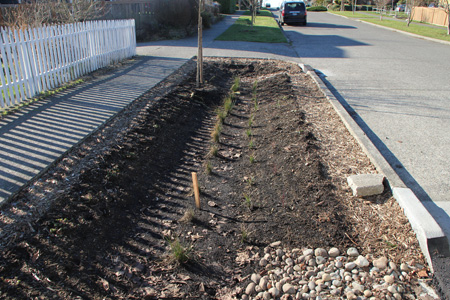
A properly draining raingarden.
The problem, according to community members, is nearly half of the roadside raingardens don’t work properly. In the raingardens that don’t drain, inches of water will sit in the bottom for days after it stops raining. Andrew Lee the Combined Sewer Overflow manager for Seattle Public Utilities, acknowledges that there is a problem. “What we’ve seen is that some of these raingardens are not performing the way that the tests indicated they would,” Lee says. “They’re performing actually much worse.” The design standards call for the gardens to drain within 72 hours after the rain stops, a timeframe that some residents think is too long.
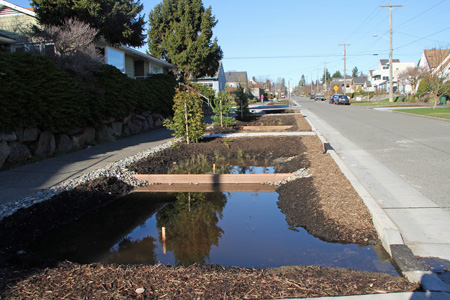
Nearly half of the roadside raingardens aren’t draining properly.
“We find ourselves in a difficult and surprising position with this project,” Nancy Ahern the Deputy Director of Seattle Public Utilities told residents. She says that Seattle Public Utilities has built successful raingardens in other parts of the city with happy citizens. That doesn’t seem to be the case in Ballard. “To be clear, we are very supportive of the raingardens,” Karrie Mathison said during a presentation by residents, “the point is we want them fixed.”
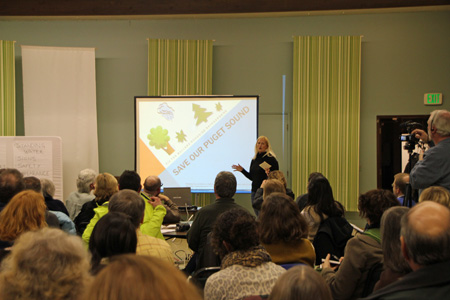
Residents put together a presentation for SPU.
During the two and a half hour meeting, many residents voiced their displeasure at many parts of the raingardens – the depth of them, the steep slopes, the standing water and the signage that the Seattle Department of Transportation requires. “We don’t believe that these are something that should be in our neighborhood,” one resident said, comparing the raingarden to a detention pond.
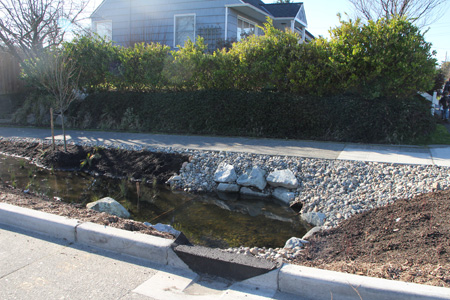
One of the raingardens with a steep slope.
A main theme throughout the meeting was the lack of communication between SPU and residents. “I would ask you, first of all, to be straight and honest with us as this develops and pay attention to the real needs of the community,” another resident told the contingent from SPU. That is exactly what SPU intends to do. “We are interested in partnering with the Ballard community,” Ahren tells us after the meeting. Within a week residents will get communication from SPU, Ahren says, and they will reach out to key leaders in the community to possibly create a task force. The plan is to work with the community to define what a successful raingarden is, she tells us.
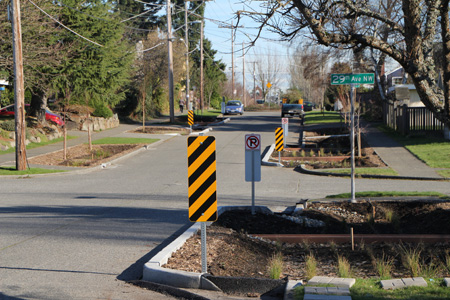
Signs required by SDOT for the “bump out” raingardens.
The first course of action for SPU is to address the standing water. “Our first objective is to get the non-performing rain gardens to drain so we don’t have the standing water,” Lee told the group. “We fully understand the safety concerns that people have.” The department will do a retrofit to the non-performing raingardens as soon as possible to get them draining, although this may not be a final solution. Ahren wants the community to have a voice in what that final solution might be. If the raingardens that aren’t working can’t be fixed, SPU is willing to take them out and restore the street to the way it was, Ahren said at the meeting.
The roadside raingardens is a pilot project for SPU to create a solution for Ballard’s Combined Sewer Overflow issues. If this first project is deemed successful, other parts of Ballard may get these raingardens. You can read more about the project here.