
This soaking rain we’re having has to go somewhere, and Seattle Public Utilities wants it to soak back into the ground instead of flowing into our waterways. Excess storm water runoff can cause erosion, sewer backups and send pollutants into our salmon-spawning streams and swimming beaches. Tracy Tackett with Seattle Public Utilities says that adding a rain garden or a cistern to your property is an easy way a homeowner can help that rainwater soak into the ground. At this week’s Ballard District Council meeting, Tackett gave a preview of a new program called RainWise, which offers a pretty good incentive to get involved – up to 100 percent reimbursement.
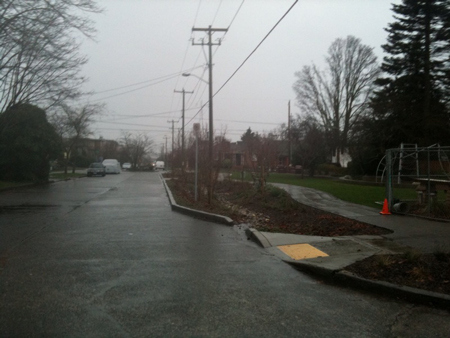
SPU is rolling out the RainWise program in Ballard in a couple of months to help homeowners manage storm water. Homes between 65th & 85th and 15th & 33rd can take advantage of the program. Under RainWise, the city will reimburse homeowners for the addition of a raingarden, help them construct a curb bulb (like the one shown above at Ballard Corners Park,) or replace the water-repelling pavement in your alley with a more earth-friendly permeable pavement. If you’ve got a 10 foot-wide planting strip in front of your house, a rain garden can easily go there, Tackett says. The six-foot strips are too narrow to work with. “If the resident is interested in the curb bulb design, that takes away a minimum of one parking space, and ideally is the length of 2-3 parking spaces,” Tackett tells us, “We are interested in pursuing curbbulbs only along frontages where the homeowners contact us to solicit the change.”
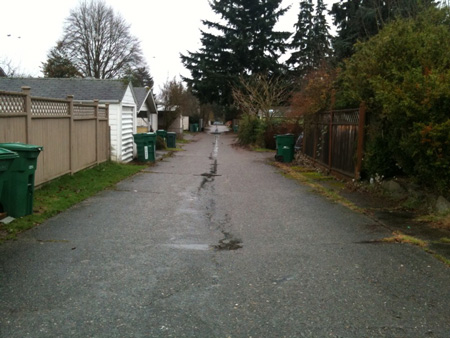
Although the official roll-out for the program isn’t until March, homeowners can sign up now. According to Tackett, the city will pay 100 percent of the cost for early birds. “Early adopters are higher incentive because they will help us ensure we have worked through any kinks in our new program,” Tackett says. If you sign up later, the city is still willing to reimburse you for possibly 90 percent of the cost. This money comes from the Seattle Public Utilities drainage and wastewater fund, specifically the funds allocated to combined sewer overflow reduction. “We anticipate a high demand for the roadside raingardens,” Tackett says, “We will prioritize blocks that have a high level of support by the full block, where the block works among themselves to say where curb bulbs are desired along the length of block.”
Subscribe
33 Comments