Ballard Cooks teaches students the joy of cooking
We’ve all heard it before – eat your fruits and veggies, cook with fresh ingredients, stay away from fast-food and pre-packaged dinners and you’ll be a healthier person. Now Ballard …

We’ve all heard it before – eat your fruits and veggies, cook with fresh ingredients, stay away from fast-food and pre-packaged dinners and you’ll be a healthier person. Now Ballard …
The family of 61-year-old Queen Anne resident Phil Irwin say he has gone missing and are trying to find any information about where he might be. Emily Irwin, Phil’s daughter …
The new Interbay Farmers Market opens today from 3 to 7 p.m. in the Whole Foods parking lot on 15th Ave West. This is the market that was at the …
Loyal Heights Community Center (2101 NW 77th St) is celebrating the beginning of summer with their Hawaiian BounceFest. On Friday from 4:30 to 6:30, let your kids jump away in …
Ballard High School receives very little money for its music program and athletics. In order to supplement the costs, the Ballard High School Foundation holds fundraisers to raise money for …
Updated: According to police, a drunk driver caused a crash last night at the intersection of Leary Ave NW and NW Market Street. Police say they responded to the scene …
Bertha Davis, the 97-year-old visionary who was the momentum behind the “Bring the Ring back to Ballard” campaign, will be remembered today. The “celebration of life” event will be held …
Ballard is getting a new Irish pub and the owners know a thing or two about the business. The Tellefson family owns Sully’s Lounge (1625 Queen Anne Ave N) on …
Since 1936 a totem pole has watched over the Totem House restaurant – until today. The rotted, weathered pole is no longer there. While John Shepherd is busy renovating the …
The new Kirke Park at 7028 9th Ave NW will have the traditional park amenities like a play area for kids and a grassy area for lounging. It will also …
It’s time once again to vote for your favorite farmers market in the country. Last year, Ballard’s was chosen as the best in the state, but didn’t make the national …
By Allison Barrett
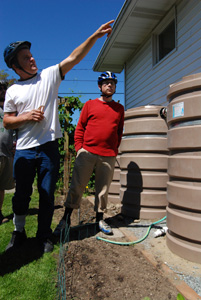 On the side of Mark Davison’s house stands a huge tank. Over 6 feet tall, the cistern is designed to capture runoff from his roof. It only drains a small, 400-square-foot portion of the roof, but during a recent spring rainfall that section of the roof produced enough runoff to fill the 650-gallon tank to the brim.
Without the tank, those hundreds of gallons would have poured directly into Ballard’s sewer lines, an outdated system that frequently overfills and dumps a mess of dirty rainwater and raw sewage into Salmon Bay, making Ballard one of the city’s top perpetrators of polluting Seattle waterways during a rainstorm.
But the city is offering Ballard residents ways to slow down the rain, diverting it into cisterns and rain gardens, as part of a program that is designed to decrease the frequency of polluted overflow.
“We took away a lot of natural infrastructure for dealing with rain,” said Ann Butler, who works with People for Puget Sound and helped lead a bicycle tour on Saturday, June 4, to look at Ballard homes with successful catchment systems.
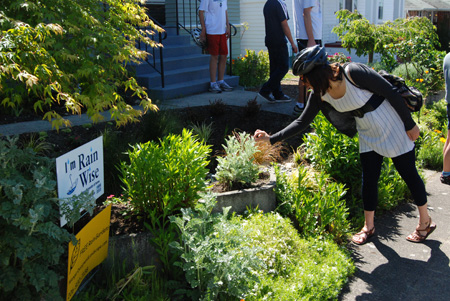
An intern with People of Puget Sound examines the landscaped retaining wall on a Ballard rain garden. They can vary in design depending on the site.
Impervious rooftops and hard cement surfaces funnel rain into our waterways instead of letting it filter into the ground, she said. On the way, runoff picks up all kinds of pollutants like heavy metals, oil and fertilizer chemicals.
“Percolating it into the ground slows the process,” Butler said.
And the city has to slow the process and cut back on the occurrence of sewer overflows in order to comply with the Clean Water Act. According to Seattle Public Utilities, there are two major sewer outfalls in Ballard that comprised about one quarter of the city’s entire overflow problem in 2010. More than 43 million gallons of sewage and stormwater were discharged into Salmon Bay. Sometimes the overflows happened after as little as one tenth of an inch of rainfall.