
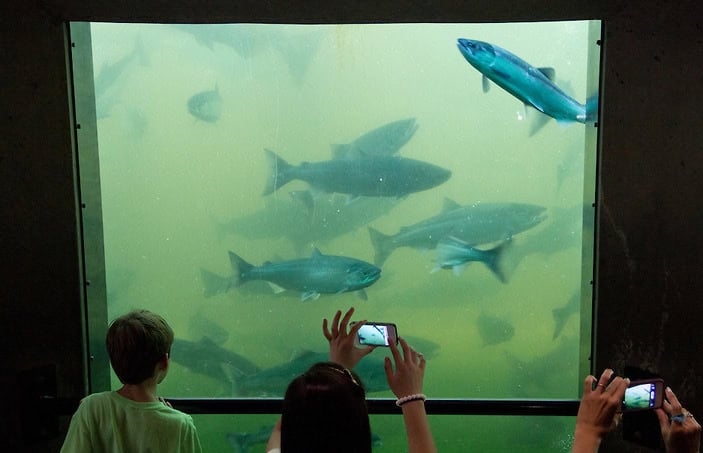
The number of sockeye salmon passing through the Ballard Locks Fish Ladder is at all-time low, according to yearly counts dating back to the 1970s.
According to the Washington Department of Fish and Wildlife’s daily count, just 16,000 sockeye have been counted at the fish ladder during their upstream migration this summer.
Aaron Bosworth, a fish biologist with the Washington Department of Fish and Wildlife, says it’s cause for concern. “This is the lowest sockeye count ever recorded at the Locks,” Bosworth says, and it’s been trending this way for the past few years.
He says there are a couple of factors at play.
One of the major issues is juvenile predation. Sockeyes spend about a year in Lake Washington before they head out to sea, and during this time, their numbers drop significantly due to predation.
Of several million fry that make their into the lake every late winter/early spring, just a tiny percentage make it out to sea through the Ballard Locks. Bosworth describes Lake Washington as a “bottleneck to their survival”, saying he believes warmer lake temperatures are a factor.
“The lake warms up sooner and stays warm longer, so that makes all non-native fish more hungry,” he says. Another factor leading to higher predation is light pollution: skyglow means predators are better able to hunt at night.
One way to mitigate the predation rates, Bosworth says, is to keep juveniles in Cedar River hatcheries for a longer period each year. By allowing them to grow larger before they make their way to Lake Washington, they may fare better against predators.
However, the City of Seattle owns the Cedar River hatchery, and Bosworth says they’re resistant to the idea.
Along with predation, disease is a major factor for sockeye survival.
Bosworth says they’re seeing a much higher disease rate among adult sockeye who pass through the Locks and Ship Canal on their way to the Cedar River watershed to spawn.
For example, of the 30,000 that passed through Locks last year, only 7,000 made it upstream to spawn. Again, he believes warmer temperatures are a factor — warm water means more pathogens.
The sockeye decline is expected to continue — Bosworth says that one model estimates they could disappear altogether in 40 years.
There are some ecosystem impacts, including a reduced amount of nutrient exchange in the Cedar River watershed. However, the larger impact is social.
“People want sockeye to be here and in Lake Washington. It’s remarkable to have a run of salmon,” Bosworth says.
“But the salmon population is just not healthy anymore.”