
Seattle Mayor Bruce Harrell is calling on Sound Transit to control costs and keep the Ballard and West Seattle light rail extensions on schedule, despite the agency projecting a cost increase of up to $30 billion across its voter-approved expansion program.
At an August 28 Sound Transit Board meeting, officials reported that cost estimates for the ST3 plan had grown by 20 to 25% beyond the long-range financial plan. Harrell said the added costs are significant but should not delay projects that serve the city’s densest neighborhoods.
“Major infrastructure projects like light rail expansion are facing significant cost pressures nationwide, but we cannot allow these challenges to derail our commitment to Seattle voters who overwhelmingly supported this investment,” Harrell said in a statement.
Staffing and permitting changes
To keep the projects on track, Harrell is advancing legislation to expand the city’s light rail staffing team. According to a press release, the new staff would work in partnership with Sound Transit to help accelerate permitting and planning.
The Seattle Times reported that the team would include about 50 planners, engineers, and inspectors, led by longtime city engineer Angela Brady, who oversaw both the waterfront redevelopment and the Mercer Street rebuild. The effort is expected to cost about $10 million annually, with most of the funding reimbursed by Sound Transit.
Harrell previously signed legislation in July to update Seattle’s land use code, which aimed to simplify and speed up permitting for the Ballard and West Seattle Link Extensions. The law seeks to cut review times from an average of 240 days to 120 days, and it expands staffing and outlines a four-year work plan to support the effort. Councilmember Dan Strauss, who represents Ballard, said the legislation “is all about cutting red tape and delivering results. It’s about getting ourselves out of our own way and on track to fulfilling the promises made to voters.”
These changes build on an executive order Harrell signed earlier this year to cut permitting times in half, from 240 days to 120, for the West Seattle and Ballard extensions. The streamlined process includes standardized landscaping plans, tree and vegetation management, accessibility improvements for pedestrians and cyclists, and a more efficient appeals process.
Cost-saving measures
The mayor is also urging Sound Transit to explore cost-saving strategies, including commissioning a third-party review of its assumptions around costs, revenues, and risks. He said the city is open to “out-of-the-box ideas” to save money.
One such idea, mentioned at Tuesday’s news conference in Ballard and reported by the Seattle Times, is a single downtown tunnel that would connect Ballard trains at Westlake Station and West Seattle trains at Stadium Station. The approach is meant to save money compared to building a second tunnel with deep stations, but it has not yet been analyzed, and questions remain about whether one tunnel could handle future demand.
Project timelines
The West Seattle Link Extension is scheduled to open in 2032, with new stations in SODO, Delridge, and West Seattle. The Ballard Link Extension, which would add stations in Chinatown-International District, South Lake Union, Seattle Center, Interbay, and Ballard, is expected to begin service in 2039. Together, the two projects would add 11.8 miles of light rail and 13 new stations.
Sound Transit currently sees up to 3.4 million boardings per month. Once complete, the extensions are expected to add hundreds of thousands of daily riders, including more than 200,000 daily boardings at new stations.
Regional debate
The mayor’s push comes as Sound Transit board members weigh whether to prioritize the regional “spine” from Everett to Tacoma over city extensions as costs climb. Snohomish and Pierce County representatives have voiced concerns that Seattle’s projects could consume a disproportionate share of the agency’s resources, according to the Seattle Times.
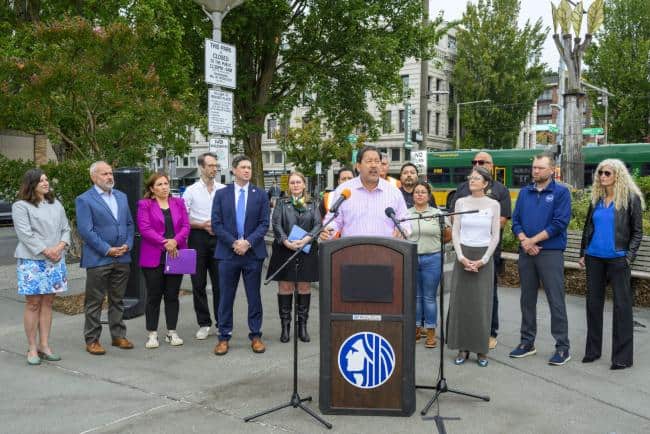
Speaking in Ballard on Tuesday, Harrell emphasized that the city’s densest neighborhoods, such as Ballard and West Seattle, should remain the top focus for Sound Transit’s expansion efforts. He argued, according to the Seattle Times, that investments should go where ridership demand and job growth are highest.
Councilmember Strauss echoed the urgency in the city’s press release: “Failure is not an option, and the City of Seattle is working to cut red tape and ensure Sound Transit delivers this critical infrastructure as fast as possible.”
Photo: City of Seattle