
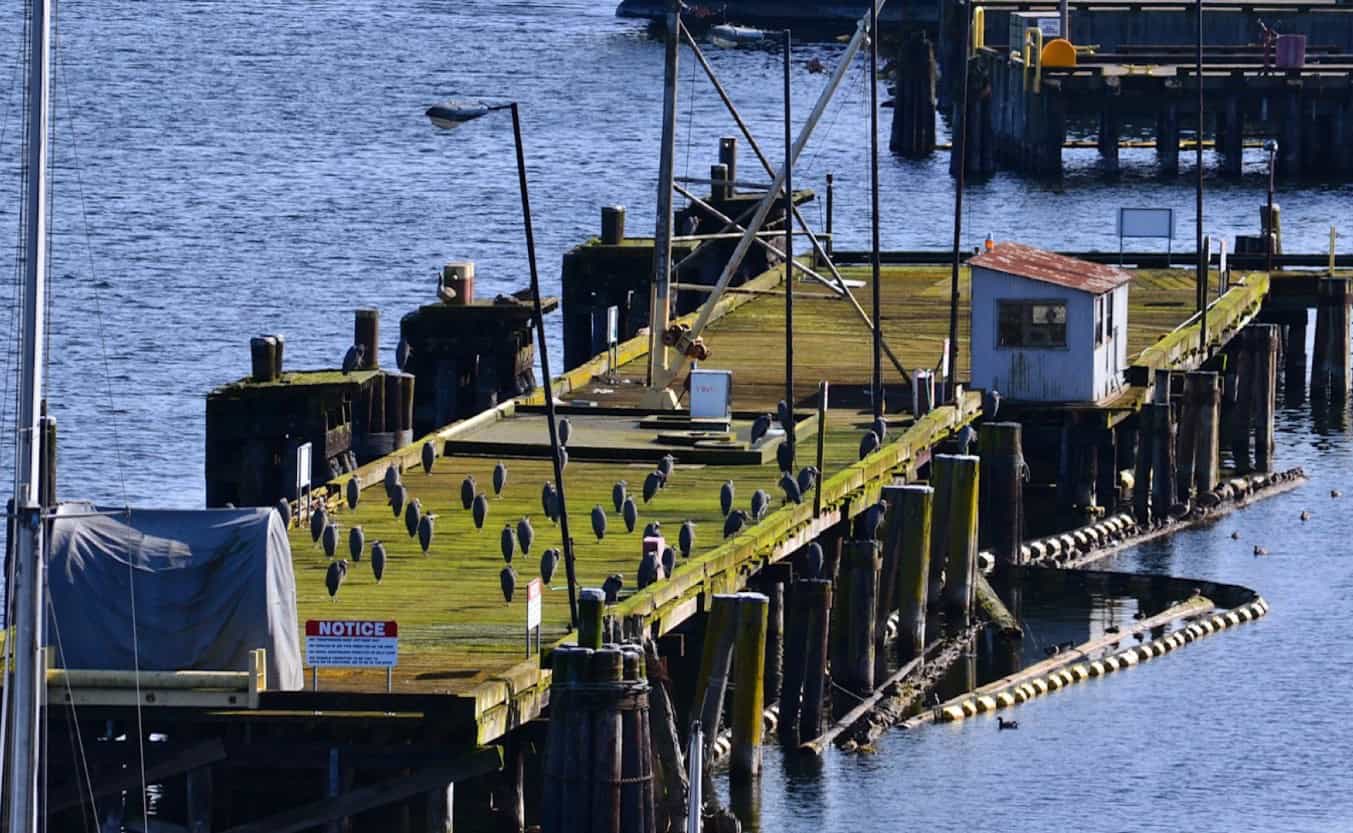
Heron Habitat Helpers (HHH) is urging the City of Seattle to require additional environmental review and protections for a proposed shoreline redevelopment near the Ballard Locks, citing concerns about potential impacts to Seattle’s largest great blue heron nesting colony.
HHH announced Monday that it has submitted comments on the proposed Terminal One development at 2750 W. Commodore Way. According to the organization, public comments on the project will be accepted through June 26.
The proposal includes a new marine sales and services building, a bulkhead, boardwalk, docks, removal of existing piers, floats and piles, and parking for 75 vehicles.
In its letter to the city, HHH says the project is located near the great blue heron colony at Commodore Park, which it says had 63 nests in 2026 after the birds relocated from Kiwanis Ravine. The group notes that Seattle has designated great blue heron habitat as an Environmentally Critical Area and adopted Director’s Rule 13-2018 to guide management of nesting colonies.
Among its requests, the organization asks the city to clarify how Director’s Rule 13-2018 applies to the proposal and to ensure the project complies with required buffers, seasonal timing restrictions, and limits on construction-related disturbance.
The letter also raises concerns about plans to remove existing piers, floats, and pilings, which the organization says currently serve as staging habitat where great blue herons gather before nesting.
“Great blue herons use pre-breeding “staging” sites to gather, display courtship behavior, and establish pair bonds prior to moving into the nesting colony,” HHH wrote in its letter. “Removing these structures without replacing their ecological function risks degrading essential behavioral habitat that supports successful nesting at Commodore Park.”
HHH is asking the city to require an evaluation by a qualified wildlife biologist of how removing those structures could affect heron behavior and to consider replacement structures that maintain or enhance perching and staging opportunities.
In addition, the organization is requesting a comprehensive environmental and wildlife impact analysis that examines potential effects on great blue herons, salmon habitat, and other fish and wildlife resources in the area. The group also recommends evaluating alternatives and mitigation measures, including construction timing, design changes, habitat enhancements, and lighting and noise controls.
If the project moves forward, HHH is asking the city to prohibit high-noise construction during heron nesting and pre-nesting seasons within applicable buffers unless a qualified biologist determines there is no active nesting or significant disturbance risk. The group is also requesting year-round and seasonal buffer protections and construction practices designed to reduce lighting, noise, vibration, and in-water disturbance.
“These measures would align the project with Seattle’s adopted great blue heron management framework and broader policies to protect environmentally critical areas and wildlife habitat,” HHH wrote.
Public comments are open until June 26.
Photo: Herons on the existing dock at the development site, courtesy of Heron Habitat Helpers