
Sound Transit says light rail service to Ballard could be a reality by 2042 if it can reduce project costs and secure additional funding to start construction by 2033.
Sound Transit announced the latest timeline on Friday, outlining project milestones it says must be met to keep the Ballard light rail extension on track. However, if they can’t meet those goals and the agency has to rely on existing revenue, the full Ballard line may not happen until 2060.
The update comes two months after the Sound Transit Board adopted a revised Sound Transit 3 (ST3) System Plan to address the $34.5 billion funding gap. Sound Transit is now committing $18.1 billion to building the Ballard line.
The agency said the updated plan also provides $300 million to complete design work for the Ballard link, which will let Sound Transit explore cost savings and pursue additional funding opportunities.
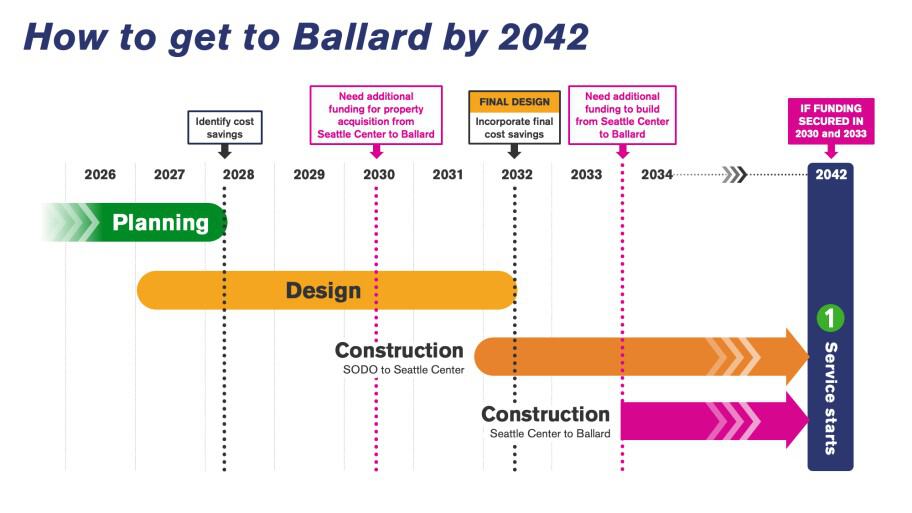
Here are the milestones Sound Transit outlines as necessary for staying on schedule for a 2042 opening:
- By 2030: Identify approximately $1 billion in additional cost savings or financial capacity to begin acquiring property between Seattle Center and Market Street.
- By 2032: Complete final design, providing a clearer understanding of project costs and remaining opportunities for savings.
- By 2033: Secure the funding needed to build the full extension and preserve the opportunity for a 2042 opening.
Seattle City Councilmember Dan Strauss, who also serves on Sound Transit’s board, has been an adamant supporter of light rail to Ballard, pushing Sound Transit to maintain the Ballard extension despite the agency’s recent plans failing to include the Market Street line.
Strauss voiced optimism on Friday regarding Sound Transit’s latest project outline.
“Light rail to Ballard is not dead. Today’s announcement shows us the way to get Ballard Link back on track. I asked for Sound Transit to provide this date range to increase transparency for the public and provide us all a clear vision of the work we must do together to deliver light rail to Ballard,” Strauss said.
Sound Transit said it plans to continue reducing costs while pursuing additional financial capacity through strategies such as longer bond terms, increased debt capacity, station-area value generation, permitting reforms, and third-party funding. The agency said similar design work on the West Seattle Link Extension has already identified between $2.2 billion and $2.6 billion in cost savings.
If those savings and funding sources are not secured, Sound Transit said the extension beyond Seattle Center would likely wait until existing revenues accumulate, delaying service to Smith Cove, Interbay and Market Street until around 2060.
“We always knew that without additional resources or cost savings, the date would be unacceptable. Now, we are unified on the work we must do to move that date sooner,” Strauss said.
Photo: Sound Transit