
By Joe Veyera
A new report released by King County Metro says that RapidRide D Line riders are more satisfied with service on the route than they were a year ago.
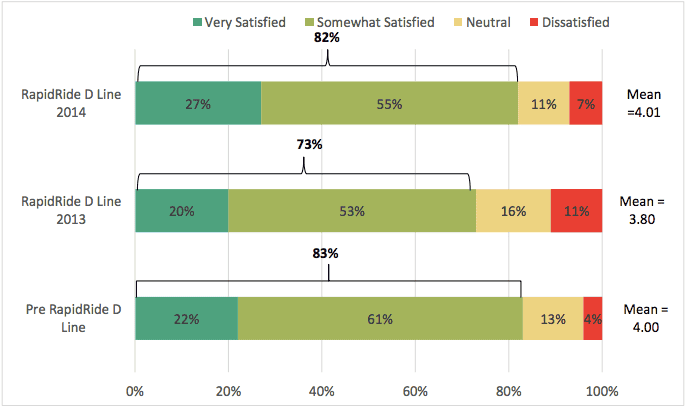
Over 500 riders of the route, which connects Ballard and Crown Hill with Downtown Seattle, were surveyed, with satisfaction ratings rebounding to pre-RapidRide levels, when the corridor was served by Routes 15 and 18.
27 percent of riders surveyed said they were very satisfied overall with the service, up from 20 percent a year ago, and from 22 percent pre-RapidRide. 55 percent of riders reported being somewhat satisfied, up from 53 percent a year ago, but down from 61 percent before RapidRide’s introduction.
Riders also reported being happier with how long their trips take, with 76 percent of respondents saying they were satisfied or very satisfied, up from 67 percent last year, and 70 percent pre-RapidRide.
Frequency and reliability were also with riders reporting significantly higher satisfaction ratings compared to 2013 when it came to on-time performance (78 percent to 64 percent), frequency of peak hour service (79 percent to 66 percent), mid-day service (69 percent to 60 percent), weekend service (59 percent to 52 percent), and evening and nighttime service (56 percent to 50 percent). Those numbers were all also considerably higher than those measured pre-RapidRide.
The results were mixed when it came to the overall satisfaction with waiting areas and bus stops, when compared to pre-RapidRide survey results. While 79 percent of respondents said they were satisfied or very satisfied with the convenience of stops to their homes or where their trips started, up from 76 percent a year ago, that number was still much lower than the 85 percent pre-RapidRide. 69 percent of riders said they were satisfied with the information available at stops about routes or connection, up from 60 percent last year, and 51 percent before RapidRide.
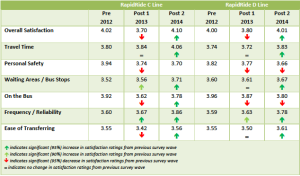
However, the satisfaction rating with personal safety has steadily decreased over the past three years. According to the report, three factors appear to contribute to the lower satisfaction ratings: personal safety on the bus, the behavior of other passengers on the bus, and the behavior of other people at the stops. 78 percent of riders reported being satisfied with their personal safety on the bus, down from 83 percent last year, and 87 percent prior to RapidRide.
Riders were also less satisfied with RapidRide’s free Wi-Fi, with 33 percent saying they were very satisfied, down from 42 percent last year. Riders also noted frustrations with their ability to get a seat, with 59 percent reporting being satisfied, same as 2013, and way down from the 76 percent pre-RapidRide.
Overall, the study noted the ease of transferring, the waiting areas and bus stops, the frequency of service on weekends, the timeliness of buses when transferring, the wait time between transfers, and the ability of riders to secure a seat on the bus, along with the behavior of other riders on the bus, as areas for Metro to improve on with the route moving forward.
To read the entire report, click here.