

By Allison Barrett
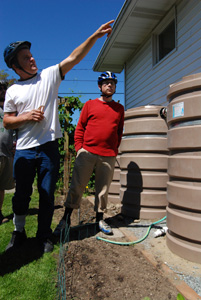 On the side of Mark Davison’s house stands a huge tank. Over 6 feet tall, the cistern is designed to capture runoff from his roof. It only drains a small, 400-square-foot portion of the roof, but during a recent spring rainfall that section of the roof produced enough runoff to fill the 650-gallon tank to the brim.
Without the tank, those hundreds of gallons would have poured directly into Ballard’s sewer lines, an outdated system that frequently overfills and dumps a mess of dirty rainwater and raw sewage into Salmon Bay, making Ballard one of the city’s top perpetrators of polluting Seattle waterways during a rainstorm.
But the city is offering Ballard residents ways to slow down the rain, diverting it into cisterns and rain gardens, as part of a program that is designed to decrease the frequency of polluted overflow.
“We took away a lot of natural infrastructure for dealing with rain,” said Ann Butler, who works with People for Puget Sound and helped lead a bicycle tour on Saturday, June 4, to look at Ballard homes with successful catchment systems.
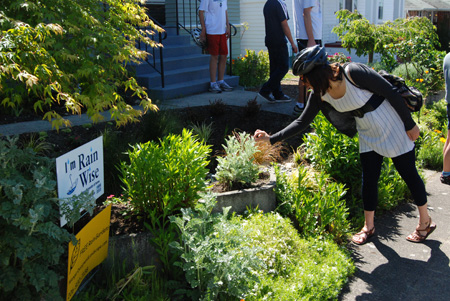
An intern with People of Puget Sound examines the landscaped retaining wall on a Ballard rain garden. They can vary in design depending on the site.
Impervious rooftops and hard cement surfaces funnel rain into our waterways instead of letting it filter into the ground, she said. On the way, runoff picks up all kinds of pollutants like heavy metals, oil and fertilizer chemicals.
“Percolating it into the ground slows the process,” Butler said.
And the city has to slow the process and cut back on the occurrence of sewer overflows in order to comply with the Clean Water Act. According to Seattle Public Utilities, there are two major sewer outfalls in Ballard that comprised about one quarter of the city’s entire overflow problem in 2010. More than 43 million gallons of sewage and stormwater were discharged into Salmon Bay. Sometimes the overflows happened after as little as one tenth of an inch of rainfall.
SPU is using a three-pronged approach to reducing the overflows. Part of the solution involves increasing the capacity of the sewage infrastructure, retrofitting the existing system as well as adding new pipes and holding tanks.
The other part relies on increasing the capacity of the soil to slow the flow of stormwater, keeping it out of the sewer system and allowing it to filter into the ground.
That’s where cisterns and rain gardens come into the picture. “Cisterns allow you to divert, capture and utilize rain runoff,” said Jim Bristow, a contractor who participated in last Saturday’s tour. Rainwater is directed off the roof and into cisterns that are equipped with a quarter-inch outflow pipe to allow for a controlled release of rainwater, a slow trickle of that soaks into the soil.
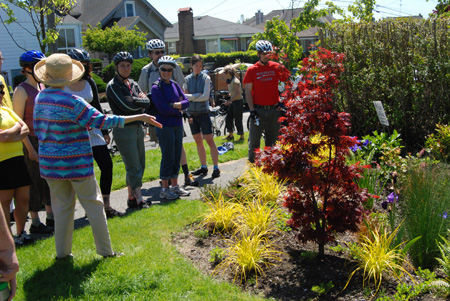
Homeowner Liz Tennant has a rain garden installed in her front yard. The rain is directed down from her roof and into a narrow cedar trough that empties into the garden. The cedar trough makes for lovely viewing when it rains, she said.
The cisterns can also be plumbed to provide water for flushing toilets or for the garden. To be able to use the water on edibles, Bristow explains that the system can be designed to do a “first flush,” directing the first bit of rainfall, which is likely to pick up more dirt and pollutants, away from the cisterns. The cistern outflow can be directed into a rain garden, a shallow depression where runoff collects and seeps into the ground. Rain gardens can also operate without cisterns, taking water piped directly from the roof.
The gardens, which are lined on the bottom with gravel and planted with certain kinds of vegetation, are designed with an emergency outflow in case a sequence of heavy rains overwhelms the garden’s capacity.
But an optimal rain garden is built in soil that has a fast absorption rate. Rain garden contractors perform percolation tests on a site before agreeing to install one, and not all yards are suitable.
“One contractor I know will do the percolation test, and if it’s really close he won’t do the garden,” said Butler. He won’t take the risk, she explained. “People need to see that this works.”
Some of the recent attention on rain gardens has been negative, focused on rain gardens where runoff didn’t soak into the soil fast enough, leaving unsightly ponds of standing water. “Some roadside installations have not worked,” said Bob Spencer, RainWise project manager. “We go back and fix them.” In the residential program there are more than 40 installations and they are all working perfectly, he said.

Homeowner Karen Ballantyne discusses rain garden design with the bike tour group.
The city is offering rebates to Ballard residents who want cisterns or rain gardens and have a yard that is suited for them. The city determined how much it would cost to build infrastructure to deal with Ballard’s overflow problem and then opted to pass that money along to homeowners who are willing to have the catchment systems installed. Ballard residents or businesses that are eligible and commit to draining at least 400 square feet of rooftop can receive a rebate of up to $4 per square foot.
“Catching rain from 1,000 square feet of roof can get you up to $4,000 in rebate,” said Spencer. After the project there are inspections.
“It is big to use public funds on private property,” said Spencer. “We have to make sure that we are getting what we promised the public.” You can get more information on the city’s RainWise program here.
If you missed last weekend’s bike tour, there is a walking tour this coming Saturday from 10 a.m. to noon. Meet at Loyal Heights Elementary School Playground (2511 NW 80th St.)
(Contributor Allison Barrett is a student in the University of Washington Department of Communication News Laboratory.)