
For the second time in a week a swarm of bees has been removed from the area, which apparently isn’t unusual for this time of year.

A swarm of bees in a tree Monday afternoon.
On Monday afternoon, a giant swarm of bees about four houses long chose a tree across the street from Jessica. “It was like Armageddon!” she tells us, of the thousands of bees swarming. The homeowner called Bruce Becker on the Swarm List kept by the Puget Sound Beekeepers Association who volunteered to come out and put the bees into a temporary hive. Becker says that a swarm can be up to 10,000 bees.
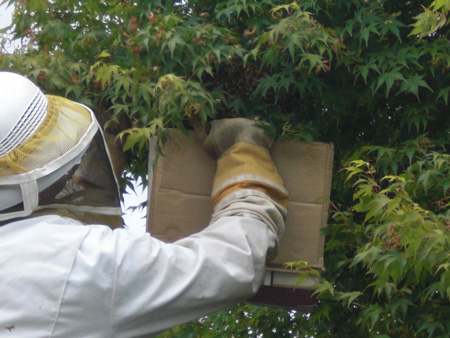
Bruce Becker with the Puget Sound Beekeepers Association removing swarm. “Surprisingly, the bees all dropped calmly into the box,” neighbor Jessica says.
We talked with Dan the Bee Man, a bee keeper in Crown Hill, who tells us that this is “swarm season.” During the spring months, Dan says, hives come back to life and bees begin making honey after a winter of staying inside the hive. To make sure she has a thriving hive, the queen can lay up to 2,000 eggs per day.
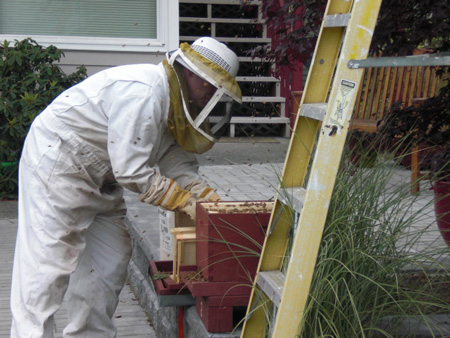
Becker putting the bees in a temporary hive.
If the queen feels the hive is getting over-populated, she’ll take half her colony and swarm. “All of a sudden droves and droves will leave the hive,” Dan says. The queen will take the population and generally end up in a tree or bush where they will stay until “scout bees” come back to report that they’ve found a place for a new hive.
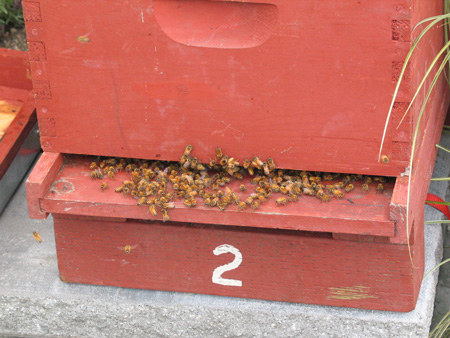
Bees can get in and out of the temporary hive through a small opening near the bottom.
“Time is of the essence,” Dan says, when capturing a swarm. The only thing they want is a new home so if a beekeeper can get there with a hive then the bees will be happy. He tells us that you want to have the bees removed while they’re hunkered down, full of honey and docile, which can be a full day. Jessica agrees that the swarm was not aggressive at all. “We stood right in the middle of the swarm for about 30 minutes while they settled into their new temporary home, without any bee protection,” she says, “They were landing all over us and nobody got stung.”
Meanwhile back at the old hive, the bees that are left behind are busy creating a new queen bee by feeding one of their own “royal jelly” to make her grow to twice the size of the others.